
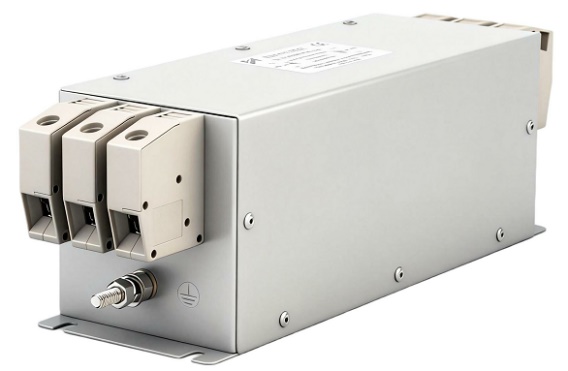
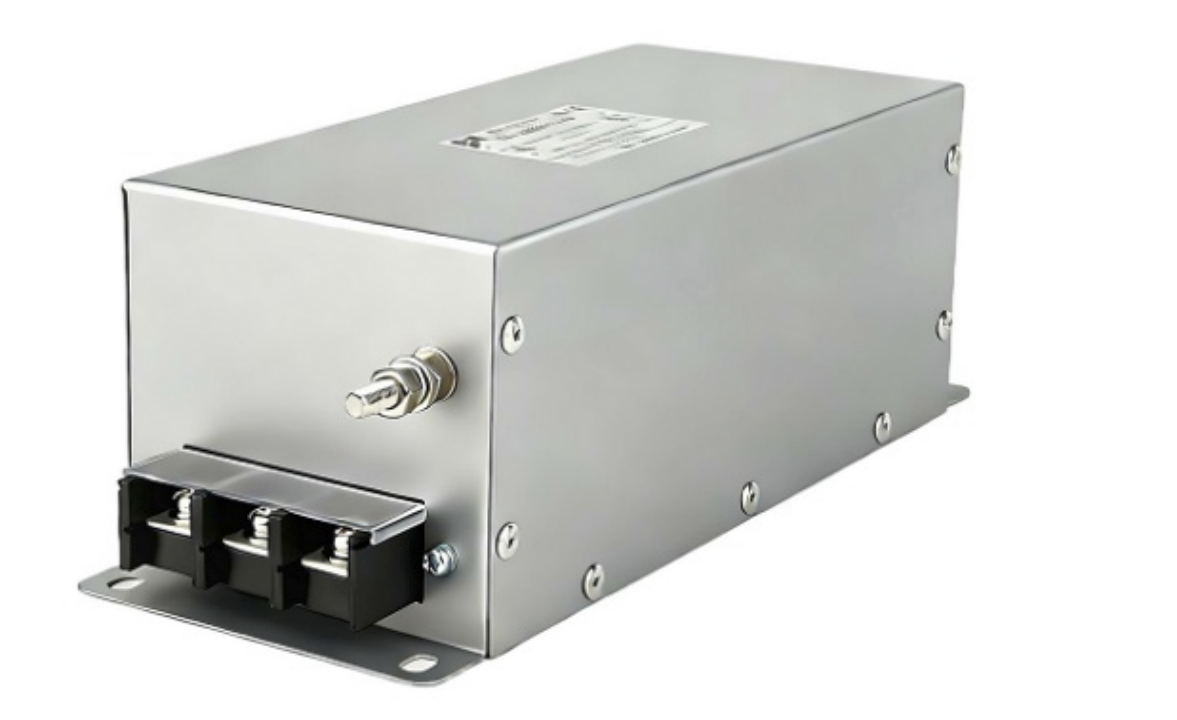
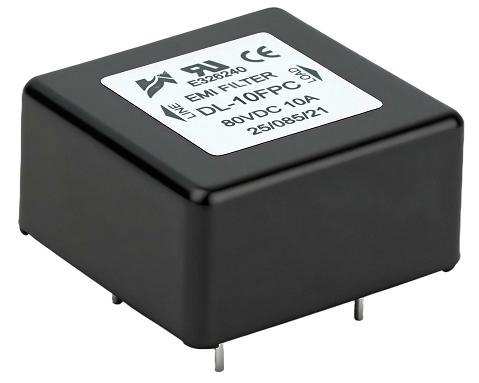
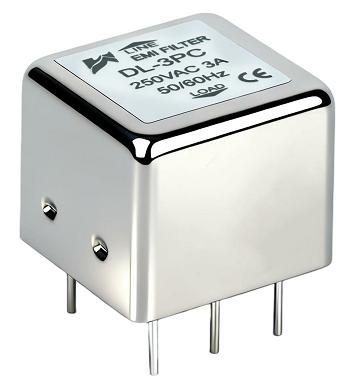
Three phase filters with neutral are four-wire EMI suppression devices designed for 3-phase+N power systems. They attenuate conducted interference on all four conductors simultaneously, ensuring compliance with IEC/EN 55011, EN 61000-4, and CISPR standards in industrial environments.
What Are Three Phase Filters with Neutral?
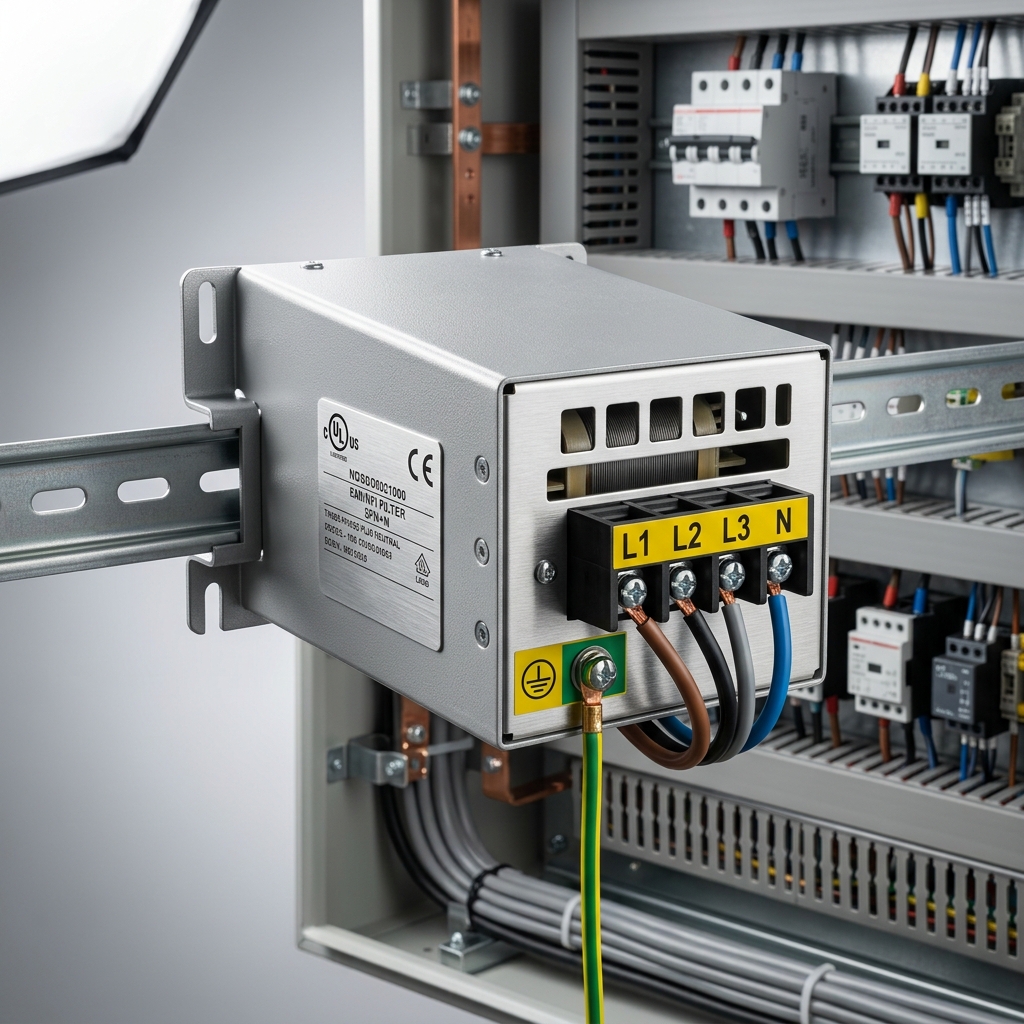
Definition and Core Architecture
A three phase filter with neutral is a passive LC network configured for four-wire (3Ø+N) power distribution systems. Unlike standard three-phase filters, it includes a dedicated neutral conductor stage.
Core components:
- Three line inductors (L1, L2, L3)
- One neutral inductor (N)
- X-capacitors (line-to-line)
- Y-capacitors (line-to-PE and neutral-to-PE)
- Common-mode choke wound on toroidal core
Key electrical parameters:
| Parameter | Typical Range |
|---|---|
| Rated Voltage | 480V / 600V AC (3Ø+N) |
| Rated Current | 6A – 2,000A |
| Frequency Range | 150 kHz – 30 MHz |
| Leakage Current | 0.5 mA – 300 mA |
| Insertion Loss (CM) | 40 dB – 80 dB @ 1 MHz |
Distinction from Standard 3-Phase Filters
- Three-wire filters handle L1/L2/L3 only; neutral noise propagates unimpeded.
- Four-wire filters suppress noise on N independently, critical where neutral carries significant harmonic current (3rd, 9th, 15th harmonics).
- Neutral current in unbalanced loads can reach 173% of phase current per IEC 61000-2-4.
How Do Three Phase Filters with Neutral Work?
Common-Mode vs. Differential-Mode Suppression
Common-mode (CM) noise:
- Flows identically on all conductors relative to PE ground.
- Suppressed by Y-capacitors and common-mode choke inductance.
- Neutral conductor carries CM noise independently in 4-wire systems.
Differential-mode (DM) noise:
- Flows between line conductors.
- Suppressed by X-capacitors and series inductors.
- Neutral-referenced DM noise requires dedicated N-stage inductance.
Neutral Conductor EMI Suppression Mechanism
In a four-wire three phase filter design, the neutral inductor:
- Presents high impedance to high-frequency neutral current.
- Blocks triplen harmonics (3rd, 9th harmonics) generated by nonlinear loads.
- Reduces neutral-to-PE conducted emissions below CISPR 11 Class A/B limits.
Insertion loss formula (simplified):
IL(dB) = 20 × log₁₀(Z_filter / Z_source)
Higher neutral inductance → higher IL → greater neutral conductor EMI suppression effectiveness.
Harmonic Current Behavior on Neutral
| Harmonic Order | Source | Neutral Accumulation |
|---|---|---|
| 3rd (150 Hz) | Switched-mode power supplies | Additive (triples) |
| 5th (250 Hz) | VFDs, rectifiers | Cancels in balanced systems |
| 9th (450 Hz) | LED drivers, UPS | Additive |
| 7th (350 Hz) | Motor drives | Cancels in balanced systems |
Triplen harmonics do not cancel in the neutral—they accumulate arithmetically, making neutral filtering non-optional in dense electronic environments.
Why Use Three Phase Filters with Neutral?
Regulatory Compliance Drivers
- IEC/EN 55011: Industrial, scientific, medical equipment conducted emissions.
- IEC/EN 61000-4-4: Electrical fast transient immunity.
- IEC/EN 61000-4-5: Surge immunity requirements.
- UL 508A: Industrial control panel standards (North America).
- CE/UKCA marking: Mandatory for equipment sold in EU/UK markets.
Non-compliance penalties include product recalls, market access denial, and liability exposure exceeding €500,000 per incident under EU Machinery Directive.
Power Quality and Equipment Protection Benefits
- Reduces neutral overheating caused by triplen harmonic accumulation.
- Extends transformer and UPS service life by reducing harmonic distortion (THD).
- Prevents nuisance tripping of RCDs/GFCIs caused by high-frequency leakage.
- Improves PLC, CNC, and servo drive reliability by reducing conducted noise floor.
Measurable outcomes:
- THD reduction: typically 30–60% on neutral conductor.
- Equipment MTBF improvement: 15–40% in documented industrial deployments.
- Energy loss reduction in neutral conductors: up to 8% in commercial building feeders.
What Applications Need Three Phase Filters with Neutral?
Industrial Manufacturing
- Automotive assembly lines: Robotic welding cells, servo presses, and paint shop VFDs generate significant triplen harmonics on shared neutral buses.
- Semiconductor fabs: Sub-micron lithography tools require neutral THD < 3% per SEMI F47 standard.
- CNC machining centers: Spindle drives and tool changers create impulsive neutral currents.
Data Centers and IT Infrastructure
- High-density server racks with SMPS loads produce neutral currents exceeding 180% of phase current.
- Industrial power quality filter neutral wire solutions are specified in Uptime Institute Tier III/IV designs.
- PDU-level four-wire filters reduce common-mode noise coupling into server BMC/IPMI circuits.
New Energy and EV Charging Infrastructure
- Level 3 DC fast chargers (150–350 kW) operate on 3Ø+N supplies; neutral filter stages prevent back-injection of switching noise onto utility feeders.
- Grid-tied solar inverters require four-wire EMI filters per IEC 62109-1 safety standard.
- Battery energy storage systems (BESS) with bidirectional converters generate asymmetric neutral currents requiring independent N-stage filtering.
Commercial Buildings and Automation
- Building management systems (BMS) with mixed LED, HVAC, and elevator loads.
- Automated warehouse logistics: conveyor VFDs and barcode scanner power supplies share neutral.
- Industrial automation panels per IEC 60204-1 machine safety standard.
How to Select Three Phase Filters with Neutral?
Selection Parameters and Decision Matrix
| Selection Criterion | Engineering Requirement | Typical Specification |
|---|---|---|
| Rated current (In) | ≥ 125% of max load current | 16A, 32A, 63A, 100A, 250A |
| Voltage rating | Match supply voltage + 10% margin | 480V, 600V, 690V AC |
| Neutral current rating | ≥ 100% of calculated neutral current | Equal to or > phase rating |
| Leakage current | Per GFCI/RCD trip threshold | < 3.5 mA (portable), < 30 mA (fixed) |
| Insertion loss target | Per applicable EMC standard | 50 dB min @ 1 MHz for CISPR 11 |
| Operating temperature | Ambient + self-heating | -25°C to +85°C standard |
| Enclosure / mounting | Panel, DIN rail, chassis | IP20, IP54, IP65 |
Step-by-Step Selection Process
Step 1 – Load analysis:
- Calculate total connected load (kVA).
- Measure or estimate neutral current using harmonic spectrum analysis.
- Apply derating for elevated ambient temperature (typically 2.5% per °C above 40°C).
Step 2 – EMC target definition:
- Identify applicable standard (CISPR 11, EN 55032, FCC Part 15).
- Determine required insertion loss at critical frequencies (150 kHz, 1 MHz, 30 MHz).
Step 3 – Neutral current capacity:
- In environments with >20% nonlinear loads, specify neutral rating = 1.5× phase rating.
- Verify three phase EMI filter with neutral conductor datasheets explicitly state neutral current capacity.
Step 4 – Leakage current validation:
- Medical environments: < 0.5 mA per IEC 60601-1.
- Industrial fixed installations: < 30 mA per IEC 60364-4-41.
- Portable equipment: < 3.5 mA per UL 60950.
Step 5 – Mechanical and environmental fit:
- Verify IP rating for installation environment.
- Confirm terminal torque specifications and conductor cross-section compatibility.
- Review three phase filters with neutral datasheet for UL/CE/TÜV certification marks.
OEM and Custom Design Considerations
- Three phase filters with neutral OEM programs typically offer custom inductance values, footprint optimization, and integrated surge suppression.
- Three phase filters with neutral custom design services address non-standard voltages (e.g., 525V mining, 690V offshore).
- Minimum order quantities for custom configurations typically start at 50–200 units depending on manufacturer.
FAQ: Three Phase Filters with Neutral
Q1: What is the difference between a 3-wire and 4-wire three phase EMI filter?
A 4-wire filter includes a dedicated neutral inductor stage; a 3-wire filter does not filter neutral-conductor noise.
Q2: Can I use a standard three-phase filter if I have a neutral conductor?
No. Unfiltered neutral carries triplen harmonics that bypass three-wire filter stages entirely.
Q3: What current rating should the neutral conductor stage have?
Specify neutral rating ≥ 150% of phase current in systems with >20% nonlinear load fraction.
Q4: Do three phase filters with neutral require grounding?
Yes. Y-capacitors must connect to a low-impedance PE ground; ungrounded operation degrades CM attenuation by 20–40 dB.
Q5: What certifications should I verify when sourcing from a Three Phase Filters with Neutral manufacturer?
Verify UL 1283, EN 60939-2, CE marking, and RoHS compliance as minimum requirements.
Q6: How do I find a reliable Three Phase Filters with Neutral supplier or factory?
Evaluate ISO 9001 certification, published test reports per CISPR 17, and application engineering support capability.
Q7: What is the typical price range for Three Phase Filters with Neutral?
Industrial-grade units range from $45 (6A DIN rail) to $3,500+ (600A panel-mount) depending on current rating and certification level.
Q8: Are Three Phase Filters with Neutral solutions available for 690V systems?
Yes. Specialized three phase filters with neutral specifications for 690V/50Hz are available for offshore, mining, and heavy industrial applications.
Conclusion and Engineering Recommendations
Three phase filters with neutral are non-negotiable in any four-wire power system serving nonlinear loads. Triplen harmonics accumulate arithmetically on the neutral conductor—a physical phenomenon that standard three-wire filters cannot address.
Key engineering takeaways:
- Always specify neutral current capacity explicitly; do not assume parity with phase rating.
- Validate insertion loss against your specific EMC standard, not generic product claims.
- For OEM and custom design requirements, engage manufacturers offering full three phase filters with neutral datasheet documentation and application engineering support.
- Procurement teams should evaluate Three Phase Filters with Neutral solutions based on certified test data, not nominal specifications alone.
For facilities managers, electrical engineers, and procurement managers: request third-party test reports per CISPR 17 and verify neutral conductor ratings independently before finalizing specifications.
References and Standards
- IEC/EN 55011:2016+A1:2017 – Industrial, scientific, and medical equipment RF disturbance characteristics
- IEC 61000-2-4:2002 – Electromagnetic compatibility: Compatibility levels in industrial plants
- IEC 61000-4-4:2012 – Electrical fast transient/burst immunity test
- CISPR 17:2011 – Methods of measurement of the suppression characteristics of passive EMC filtering devices
- IEC 60939-2:2008 – Passive filter units for electromagnetic interference suppression
- UL 1283:2005 – Standard for electromagnetic interference filters
- IEC 60364-4-41:2005 – Low-voltage electrical installations: Protection against electric shock
- SEMI F47-0706 – Specification for semiconductor processing equipment voltage sag immunity
- IEC 62109-1:2010 – Safety of power converters for use in photovoltaic power systems
- Uptime Institute: Data Center Site Infrastructure Tier Standard: Topology (2022)